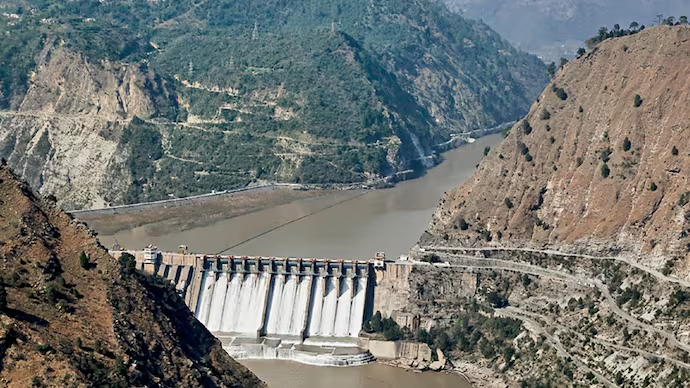
China has officially launched the construction of a massive hydropower dam on the Yarlung Tsangpo River, known as the Brahmaputra once it enters India. The ambitious project, named the Yarlung Zangbo River Lower Reaches Hydropower Project, is being built in Tibet and involves five cascade power stations, river straightening, and water diversion through underground tunnels. The total investment exceeds 1.2 trillion yuan (approx. $167.8 billion).
Chinese Premier Li Qiang attended the launch event along with top officials, engineers, and enterprise representatives, signaling the project’s strategic importance. While China claims the electricity generated will benefit the wider region beyond Tibet, the development has triggered strong concern in downstream countries—especially India and Bangladesh.
India’s Concern and Diplomatic Push
India is particularly anxious about the ecological and agricultural implications. Any disruption in the natural flow of the Brahmaputra could affect water availability, agriculture, fisheries, and flood management across northeastern Indian states like Assam and Arunachal Pradesh. Millions in India rely on the Brahmaputra basin for farming and drinking water.
Since China first announced its plans in late 2023, India has been pressing for greater transparency and consultation. In March 2025, Minister of State for External Affairs Kirti Vardhan Singh told Parliament that India had formally raised its concerns and urged China to respect the rights and interests of downstream countries.
In addition, Foreign Secretary Vikram Misri’s visit to Beijing in January 2025 saw discussions on river data sharing and the reactivation of the Expert Level Mechanism (ELM)—a dialogue platform established in 2006 to discuss water issues.
Jaishankar Raises Issue with Xi Jinping
Just days before the project launch, External Affairs Minister S. Jaishankar met with Chinese President Xi Jinping and Foreign Minister Wang Yi in Beijing. In these high-level talks, he stressed the importance of water cooperation and called for the resumption of hydrological data sharing, which is crucial for India’s flood forecasting and water management.
Jaishankar posted after the meeting:
“Incumbent on us to address aspects related to the border, normalising people-to-people exchanges and avoiding restrictive trade measures and roadblocks. Confident that on the foundation of mutual respect, mutual interest and mutual sensitivity, ties can develop along a positive trajectory.”
What’s at Stake
- Hydrological Risk: Unilateral damming could reduce water availability during dry seasons or cause artificial flooding in monsoon.
- Agricultural Impact: The livelihoods of farmers in India’s northeast could be jeopardized by inconsistent river flows.
- Geopolitical Tension: The move adds a new layer of friction in India-China relations, already strained by the border standoff.
With no water-sharing treaty between India and China, the Brahmaputra dam issue could escalate into a major flashpoint unless bilateral mechanisms are strengthened urgently.

